ISP Proxies vs Residential vs Datacenter: Which One Do You Actually Need in 2026?
Three proxy types, three trade-offs. Pick wrong and you're either paying for speed you can't use or trust scores you don't have. Here's the field-tested breakdown.
Pick a proxy type that doesn't match your workload and one of two things happens. Either you pay for residential trust scores you didn't need and watch your throughput crawl, or you grab cheap datacenter IPs and burn your accounts the second a real anti-bot vendor looks at the ASN. Most of the proxy money wasted in 2026 is wasted at this fork in the road.
If your workflow has to look like a continuous human session — multi-accounting, sneakers, social media, e-commerce automation — use static residential ISP proxies. If you need a fresh IP every request — SERP scraping, ad verification, geo-testing — use rotating residential. If you don't care about ASN-level detection — internal tooling, unprotected sites — datacenter is fine and 70% cheaper.
This guide is the field-tested version of that decision. Three proxy types — datacenter, rotating residential, and static residential ISP — broken down by the only metrics that actually matter when you're shipping work: trust score, speed, session stability, IP cost, and the platforms each one wins on.
The 60-second answer#
If you don't want to read the rest, here it is:
If your workflow needs both trust and a stable identity — pick static residential ISP proxies. They are the only proxy type that gives you both at the same time.
What is a datacenter proxy?#
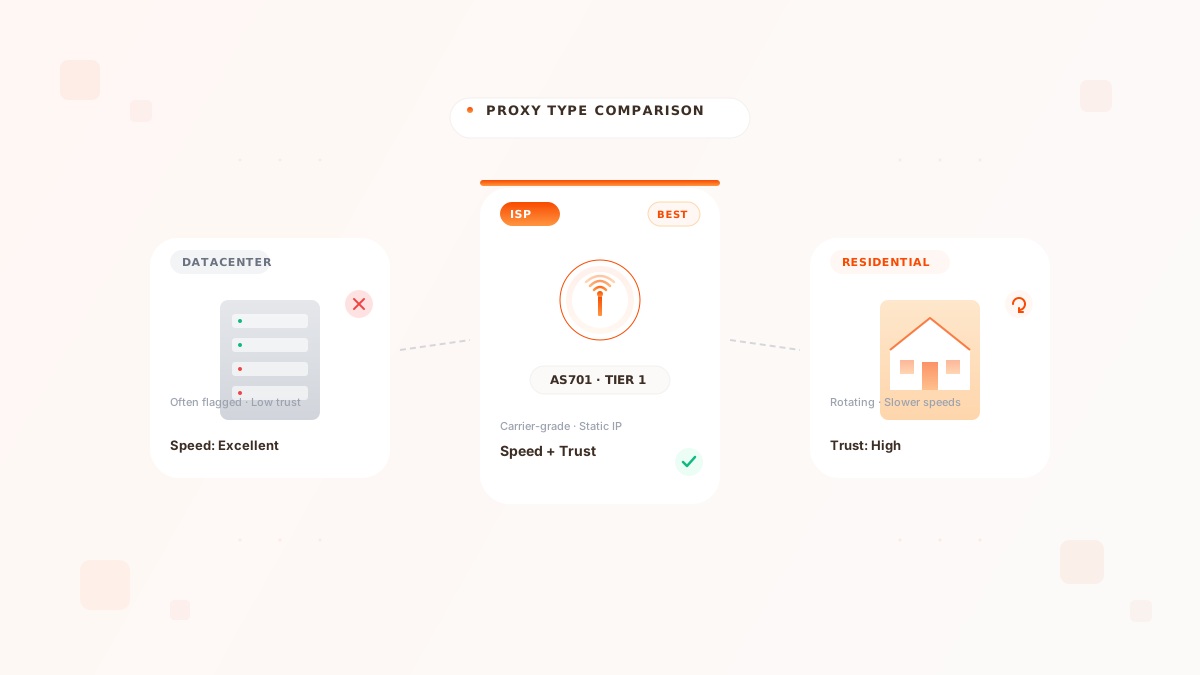
A datacenter proxy is an IP that lives in a commercial server farm. It belongs to a hosting company — AWS, Google Cloud, OVH, DigitalOcean, Hetzner, the dozens of regional clones — and any modern fraud-detection database (MaxMind[1], IPQualityScore[3], Sift, Spur[2]) flags it on sight as not a real subscriber. The ASN gives it away in milliseconds.
That doesn't make them useless. Datacenter proxies are dirt cheap (often $1-2 per IP per month, vs $4-8 for residential), they peg gigabit ports, and they're perfect for any site that doesn't bother fingerprinting the ASN — which is most of the internet, actually. If you're scraping a small e-commerce site that hasn't deployed Cloudflare's bot protection, datacenter proxies will rip through it faster than anything else and you'll never need to pay for residential.
Where datacenter proxies fall apart: anywhere with a real anti-bot vendor in the path. Cloudflare, DataDome, PerimeterX, Akamai Bot Manager, Imperva, Kasada, Reblaze. The moment one of those is in front of the site, the datacenter ASN is the first signal they look at, and you're banned before you've finished the TLS handshake.
Before you spend on residential, check whether the target site even fingerprints the ASN. Run one request from a $1/month datacenter IP. If it goes through clean, you're paying for trust scores you don't need.
What is a rotating residential proxy?#
A rotating residential proxy routes your traffic through a pool of real consumer IPs — actual home internet connections, often borrowed from peer-to-peer SDKs embedded in apps. Every request (or every session, depending on the provider) you get a different IP from a different city, sometimes a different country.
The trust score is genuinely high because the IP is a real subscriber on a real consumer ASN. The catch is the rotation itself: the very thing that makes the IP look legitimate to a fraud scorer makes it look illegitimate to a session-aware platform like Instagram or TikTok. Real subscribers don't change IP every request. Real subscribers don't suddenly become a different person mid-session.
So rotating residential is excellent for stateless workflows — SERP scraping where each query is independent, price monitoring where you just want a clean fetch, ad verification where you want a fresh perspective each time. It is awful for anything that has to look like a continuous human session.
What is a static residential ISP proxy?#
A static residential ISP proxy is the third path. The IP is sourced directly from a Tier 1 carrier — Verizon, AT&T, Comcast, Spectrum, Cox, Charter — meaning the ASN is a residential consumer carrier, not a datacenter, and not a peer-to-peer SDK pool. The fraud databases see "Verizon FiOS subscriber on ASN 701" and assign it the same trust score they'd give a real customer.
What makes it static is the second half: the IP doesn't rotate. Once it's assigned to you, it's yours alone — for hours, days, weeks. You hold the same identity across long-running sessions, which is exactly what platforms like Instagram, TikTok, X, Amazon, Nike SNKRS, and every multi-accounting browser expect from a legitimate subscriber.
The trade-off is that you don't get the geographic randomness of rotating residential. If you need to query Google SERPs from 200 different ZIP codes in the same minute, ISP proxies aren't the right tool. If you need a Verizon IP in Brooklyn that holds for the next eight hours while your bot logs into Instagram and posts, ISP proxies are the only tool.
A clean static residential ISP proxy on a Tier 1 carrier ASN reads as 0 / 100 fraud score on every major detection database — MaxMind, IPQualityScore, Sift, Spur, IPInfo. That's the difference between "this is Verizon, let them in" and "ban on sight".
Side-by-side: speed, trust, stability, price#
Here's the comparison most buying guides skip — actual numbers, not marketing hand-waving:
| Metric | Datacenter | Rotating Residential | Static ISP |
|---|---|---|---|
| Trust score | Low (datacenter ASN) | High (consumer ASN) | High (Tier 1 carrier ASN) |
| Median latency | 5–15 ms | 200–800 ms | 15–40 ms |
| Throughput | Up to gigabit | 1–10 Mbps per IP | Up to gigabit |
| IP changes | Static (manual rotation) | Every request / session | Static (yours for the term) |
| Session stability | Excellent | Poor | Excellent |
| Typical price | $1–2 per IP/month | $4–15 per GB | $3–8 per IP/month |
| Best at | Unprotected sites, internal use | SERP, ad verification, geo-testing | Multi-accounting, sneakers, social |
Which one wins for your use case?#
Multi-accounting (Instagram, TikTok, X, Reddit)
Static residential ISP, no contest. Multi-accounting depends on each profile having a stable identity across the long-running session — same IP, same fingerprint, same cookies, day after day. Rotating residential breaks this immediately. Datacenter is detected within minutes. Static ISP is the only proxy type these platforms expect a real human to be on.
Sneaker copping (Nike SNKRS, Footlocker, Yeezy Supply)
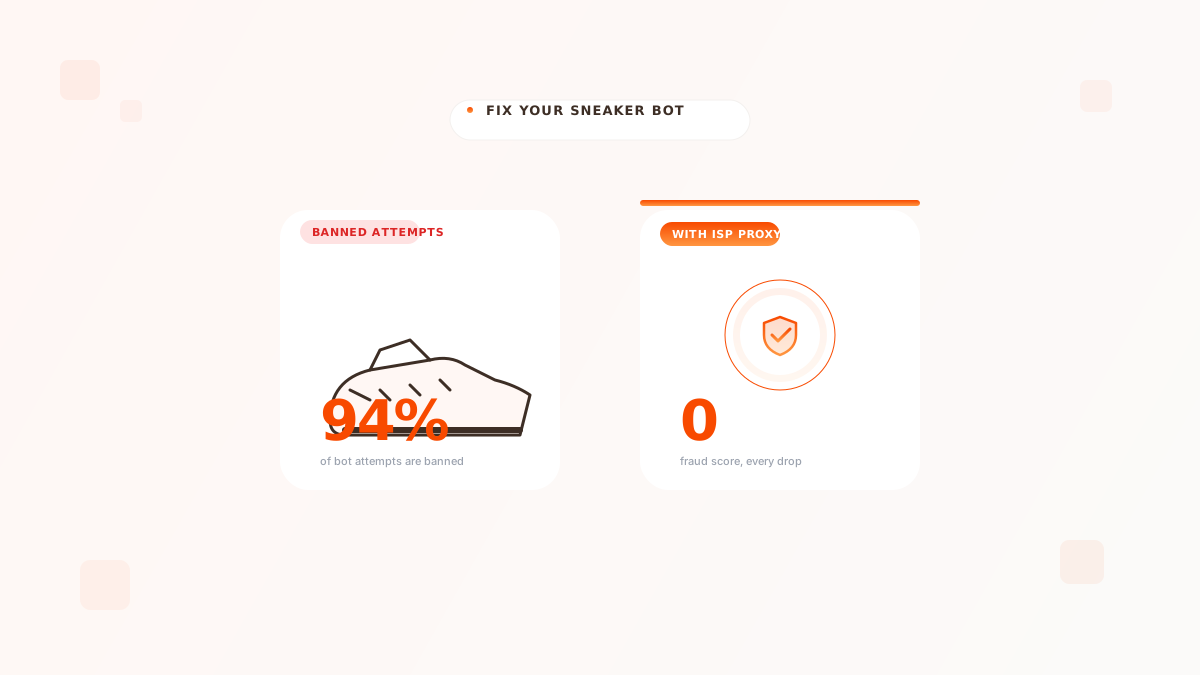
Static residential ISP. Sneaker retailers have spent ten years training their bot protection on datacenter and rotating-pool patterns. They whitelist Tier 1 carrier ASNs by default. Carrier-grade IPs from AT&T, Verizon, and Comcast are treated as legitimate subscribers and not as bot traffic — which is the entire point of paying for an ISP proxy on drop day.
Web scraping (Cloudflare-protected, DataDome, Akamai)
Either rotating residential or static ISP, depending on what the site actually inspects. If the site fingerprints session continuity, ISP wins. If the site just checks the ASN and lets you through, rotating residential wins on cost (especially for high-volume scrapes). Datacenter proxies do not survive these vendors.
Ad verification
Rotating residential. Ad verification is a stateless workflow — fetch the page, check what served, log the result, move on. You actively want a fresh IP each time, geographically distributed across the markets you're auditing. This is the one workflow where static ISP is overkill.
SERP scraping and SEO monitoring
Rotating residential for breadth, static ISP for depth. If you need 100,000 SERP queries per day across every market, rotating residential is the cost-effective answer. If you need a stable rank-tracker that can be re-run from the same identity for QA reasons, static ISP is the cleaner tool.
E-commerce automation and inventory monitoring
Static ISP. Most retailers fingerprint not just the ASN but the session history of the IP. A retail site that sees the same Verizon IP browse the same product for an hour reads "real shopper". The same retail site that sees a rotating residential IP or a datacenter IP reads "bot, ban".
Streaming geo-unblocking
Rotating residential, with caveats. Netflix, Hulu, and Max have spent years training detection specifically on residential proxy patterns and they will catch most providers. Datacenter is dead on arrival here. Static ISP works in some cases but is overkill — the moment you're rumbled the IP is dirty for the rest of its life.
The "static residential" name is misleading — read this#
One thing that trips up buyers in 2026: not every IP labelled "static residential" is actually sourced from a Tier 1 carrier. Some providers route you through a fixed IP that looks residential but actually sits on a hosting ASN with residential reverse-DNS — which fools nobody who runs ASN-level checks. When you're shopping, ask the provider for the actual ASN of the IP they're going to ship you, paste it into spur.us or ipinfo.io, and verify the carrier. The whole point of an ISP proxy is the ASN. If the ASN doesn't say "Verizon" or "AT&T" or whichever carrier they advertised, you're being sold a lemon.
How to actually pick#
The clean decision tree:
- Does your workflow have to look like a continuous human session? → Static ISP.
- Does your workflow want a fresh IP every request? → Rotating residential.
- Is the target site behind no real anti-bot vendor? → Datacenter (and save 70% of the budget).
- Are you about to log into Instagram, X, TikTok, Amazon, Nike, or any other major platform? → Static ISP, every time.
Final thought#
The difference between proxy types isn't really a difference in IP quality — it's a difference in what kind of identity you're projecting to the target. Datacenter says "I'm a server, treat me like one". Rotating residential says "I'm a different person every time you see me". Static residential ISP says "I'm a real Verizon subscriber and I'm consistent". Pick the identity that matches the work. Pay for nothing more than that.
If you're running multi-accounting, sneakers, or any platform that fingerprints session continuity, that means static residential ISP — and at that point, the question is just which carrier and which provider. You can browse the full list of Tier 1 carriers we ship from on the ISP Directory, or grab a $5 trial and test one against your exact workflow before you commit.
- MaxMind GeoIP2 — anonymous IP and ASN classification methodology
- Spur.us — proxy and VPN detection by infrastructure type
- IPQualityScore — fraud score reference and proxy classification
- Bart Proxies — ISP Directory (full list of Tier 1 carriers we ship from)
- Bart Proxies — Verizon static residential ISP proxies (AS701)
Was this article helpful?
Written by
Karam Mokdad
Founder, Bart Proxies
Karam runs Bart Proxies and has spent the last six years building proxy infrastructure for scraping, multi-accounting, and ad-tech operations at scale. He uses every product he ships.
Frequently asked questions
No. Residential proxies are typically rotating IPs from peer-to-peer SDK pools — the IP changes every request. ISP proxies are static IPs sourced directly from a Tier 1 carrier (AT&T, Verizon, Comcast, etc.), and they don't rotate. Both look 'residential' to fraud-detection databases, but the session behavior is completely different.
Yes, for the major retailers. Nike SNKRS, Footlocker, Adidas CONFIRMED, and Yeezy Supply all whitelist Tier 1 carrier ASNs and ban almost everything else. A static ISP proxy on Verizon or AT&T is treated as a legitimate subscriber on drop day. Datacenter and rotating residential proxies are typically caught immediately.
Because the IP space is harder to source. Datacenter IPs are bought from hosting providers in bulk and cost the seller almost nothing. Static residential ISP proxies require legitimate carrier IP allocation through commercial agreements with Tier 1 networks, which is dramatically more expensive — but the trust-score difference is what you're paying for.
Generally no — for serious multi-accounting, the rule is one ISP IP per account. Instagram (and similar platforms) fingerprint the IP-to-account relationship, and pointing several accounts at the same IP is the fastest way to trigger linkage detection. The whole reason to use a static ISP proxy is to give each account a stable, isolated identity.
Run the IP through spur.us, ipinfo.io, or maxmind.com. They'll tell you the ASN, the organization, and whether the IP is classified as residential, datacenter, or hosting. If the provider is selling 'static residential' but the ASN belongs to a hosting company, you're not getting what was advertised.